
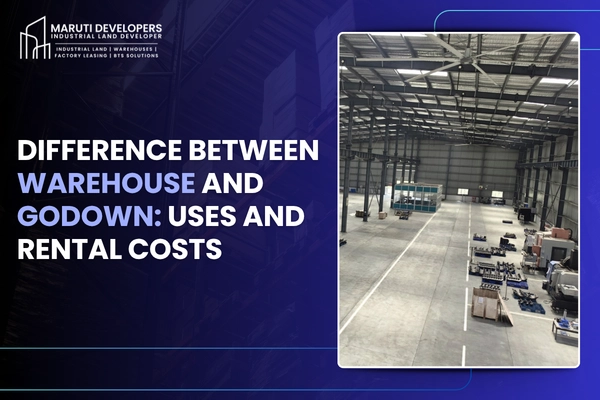
In everyday industry use, a warehouse is a planned storage facility, usually with racking, loading docks, and safety systems. A godown is usually a simpler, basic storage space where goods are mostly handled by hand. That is the main difference between a warehouse and a godown, though the two words often overlap. If you are looking for an industrial property for rent or sale, such as a warehouse or godown, knowing the difference first can save you money and trouble.
Renting is not the only way to take space. If you need storage for many years, a warehouse for lease can work out better. In this guide, we explain what a godown is, what a warehouse is, how rent is worked out, and how to pick the right one for your business.
What Is a Godown?
A godown is a basic storage building or shed. People use it to keep goods, stock or raw material for some time. The word is common in India and a few other parts of Asia.
Most godowns are simple. They have walls, a roof, and a lock. Stock is usually counted by hand. Most have limited racking, though some offer temperature control.
Because the building is often simpler, godown rent can be lower. That is not a rule, though. Rent depends on location, size and condition. For a trader with steady, simple stock, a godown is often enough.
What Is a Warehouse?
A warehouse is a large, planned building made for storing goods and moving them fast. It is built around how goods come in, sit and go out.
A good warehouse has some or all of these:
- racking and marked storage zones
- loading docks for trucks
- fire safety, CCTV and gate control
- good clear height and a strong floor
- stock software, barcodes or a WMS
You will find warehouses near highways, ports and industrial areas like GIDC (Gujarat Industrial Development Corporation) estates. E-commerce, auto parts, pharma and FMCG companies use them every day. Many also outsource daily operations to a 3PL, which is a third-party logistics company.
Not every warehouse has every feature. Always check what a specific building really offers.
What Are the Key Differences Between a Warehouse and a Godown?
The key differences between a warehouse and a godown are usually structure, technology, safety, location, size and cost. A warehouse is typically built for fast, tracked movement of goods. A godown is typically built for basic storage. These are common patterns, not strict rules.
| Feature | Warehouse (typically) | Godown (typically) |
| Structure | Planned and strong, may have docks and racks | Basic shed or building |
| Technology | May use WMS, barcodes, sometimes automation | Often manual counting |
| Safety | May include fire systems, CCTV, controlled entry | Often a lock and a guard |
| Location | Near highways, ports, industrial hubs | Often semi-urban or near markets |
| Scale | Large, many pallets, many clients | Small to medium |
| Rent | Often higher | Often lower |
| Best for | E-commerce, pharma, auto, FMCG | Local trade, grain, seasonal stock |
Warehouse, Godown and Industrial Shed in Listings
Listings also use the term industrial shed. It usually means a covered structure on industrial land, used for manufacturing, storage or both. But a label alone does not prove permitted use, build quality or suitability for your goods. If you are comparing industrial sheds for rent, ask for the approvals and the real specifications.
Uses of a Godown and a Warehouse
Where a Godown Works Well
A godown suits grain, farm produce, construction material and packed goods that do not spoil. Wholesalers use godowns to hold stock before it goes to local shops. It also fits seasonal stock, when you need space for three or four months and nothing more.
Where a Warehouse Works Better
A warehouse suits any business where speed and tracking matter. E-commerce sellers, auto part makers, pharma firms and FMCG brands rely on them. If you ship to many cities, or a customer can audit your stock, a godown may start to limit your growth.
What Are the Types of Warehouses?
Lists differ from source to source. These are seven common warehouse types and formats. They overlap. A private warehouse, for example, can also be bonded or climate-controlled.
- Private warehouse. Owned and used by one company for its own stock.
- Public warehouse. Rented out to many businesses. You pay for the space you use.
- Bonded warehouse. Holds imported goods until customs duty is paid. Common near ports.
- Government warehouse. Run by government bodies, such as the Central Warehousing Corporation and state warehousing corporations.
- Cooperative warehouse. Owned by a group of members, often farmers, who share the cost.
- Distribution centre. An operating format built to sort and ship goods fast, not to hold them for long.
- Climate-controlled warehouse. Keeps temperature steady for medicines, food and similar goods.
Many also hand daily work to a 3PL
Warehouse and Godown Rent
Warehouse and godown rent depend on where the building is, how it is built and what it offers. Rent moves with location, road access, clear height, floor strength, docks, fire safety and power load. The numbers below come from different sources, so do not mix them.
What Warehouse Rent Should You Expect?
Rent figures come from three different kinds of sources and should not be compared directly.
- Market averages. Knight Frank’s India Warehousing Market Report for H1 2026 puts average warehouse rent at about ₹19.4 per sq ft per month in Ahmedabad and ₹28.7 in Pune. These are city averages, not rates for any one site.
- Portal asking rents. Property portal listings in Manjusar GIDC, Por and Makarpura showed cover sheds at about ₹20 to ₹22 per sq ft. These are asking prices, not confirmed deals.
- Area-wise rents. The Manjusar GIDC and Dahej shed listings show approximately ₹30 and ₹25 ft. These are asking rents for those two properties as of today.
Rent moves with location, road access, clear height, floor strength, docks, fire safety and power load. If you want a godown for rent, the same rule applies. Get two or three local quotes for similar space and compare the total cost.
Note: Rent figures are indicative and change often. Always get a fresh written quote.
Godown Rent: What the Numbers Show
There is no separate rent report for godowns. Most portals list “warehouse/godown” together, so the prices overlap. These are built-up listings near Ahmedabad.
| Location | Size (sq ft) | Asking rent (per sq ft per month) |
| Pipli | 32,000 | About ₹12.50 |
| Bareja | 25,000 | About ₹13 |
| Bavla | 10,000 to 28,000 | About ₹15 |
| Changodar | 1,950 | About ₹15.40 |
| Aslali | 12,000 | About ₹15.80 |
| GIDC Naroda | 61,000 | About ₹22 |
| Shahibaug (city) | 420 | About ₹36 |
Note: Rent figures are indicative and change often. Always get a fresh written quote.
What this tells you:
- Larger godowns on the outskirts mostly ask ₹12.50 to ₹16.
- Industrial estates such as GIDC Naroda ask more.
- Very small city godowns cost the most per sq ft.
We worked these out from the listed price and area. The portal does not always state the rent period, so confirm the rent is monthly. These are asking rents, not deals.
Rent changes with location, road access, clear height, floor strength, docks, fire safety and power load. The same rule applies if you want a godown for rent. Get two or three local quotes for similar space and compare the total cost.
What Factors Affect Warehouse and Godown Rent?
Rent depends on more than location and size. The main factors are:
- Location: Closeness to highways, industrial hubs, suppliers and customers.
- Building specifications: Clear height, floor load, truck access and docks.
- Facilities: Fire protection, security, power supply and temperature control.
- Chargeable area: The rented area can be larger than the area you can really use for stock.
- Agreement terms: Tenure, lock-in, yearly increase and who pays for maintenance.
Is Godown Rent a Direct or Indirect Expense?
In many businesses, godown rent is treated as an overhead, which means an indirect cost. It supports the whole business and is hard to tie to one unit of product. But treatment can differ by how you use the space and by your accounting policy. Check with your CA before you book it.
Warehouse for Rent vs Warehouse for Lease
Many listings use the two words for the same thing. What really matters is the written agreement. In general, rent points to a shorter, flexible stay, and lease points to a longer commitment. But there is no fixed rule on tenure, and practice varies by agreement and state.
So read the actual agreement and check:
- the tenure and any lock-in period
- registration and stamp duty needs
- the yearly rent increase
- who pays for maintenance and repairs
- notice and termination terms
- whether you can add racking or make changes
Choose a shorter, flexible agreement when your stock or demand is not settled. Choose a longer lease when the location is core to your business, like a plant or a 3PL setup. Read the lock-in and exit clauses line by line. That is where disputes commonly begin.
Which One Is Right for Your Business?
Choose a godown if:
- your stock is small, simple and low risk
- you need space for a short time
- your budget is tight and you do not need tracking
Choose a warehouse if:
- you ship to many cities or many customers
- you need stock tracking, safety rules or audits
- you plan to grow in the next few years
Picture a grain trader who keeps bags for four months. A godown fits him well. Now picture an online seller who ships 300 orders a day. She needs racks, barcodes and quick loading, or a 3PL to run it for her. A warehouse fits her. A manufacturer storing machine spare parts or packaging material has different needs again, such as stronger floors, wide truck access and a clear layout. Whether a space suits your goods always depends on the actual facility and its permitted use.
Not sure? Ask yourself three things. Do your goods move fast? Do they get damaged easily? Does anyone audit your stock? If most answers are yes, a warehouse is the safer choice. If most answers are no, such as slow-moving, low-risk stock that nobody audits, a godown is often enough and costs less.
Checklist Before You Rent or Lease a Warehouse or Godown
- Check the title and the owner’s papers.
- Confirm that the land use allows storage.
- Ask for building approvals and, where they apply, occupancy and fire compliance papers.
- Check access rights, truck access, road width and turning space.
- Check floor strength, clear height, docks and power load.
- Get the total monthly cost in writing.
- Confirm in the agreement which activities are allowed.
- Visit the site yourself, ideally after rain.
Common Mistakes to Avoid
- Comparing only the rate. One owner quotes on covered area, another on the full plot. Ask which area the rate applies to.
- Forgetting truck movement. A big container truck needs room to turn. A narrow gate can slow every delivery.
- Trusting words, not papers. Ask for the title and approvals first. A good owner will not mind.
Conclusion
A godown is basic storage, often at lower cost. A warehouse is planned for speed, tracking and safety. Neither is better in every case. The right one fits your goods and your growth.
Whether you pick a warehouse for rent or a longer lease, check the title, the total cost and the exit terms before you sign. If you want a second opinion, contact Maruti Land Developers, an industrial real estate agency in Vadodara that advises on industrial sheds, warehouses and godowns, mainly in Gujarat and other industrial regions across India.
FAQs
Q. What is the difference between a warehouse and a godown?
Ans. A warehouse is generally built for organised storage, stock control and fast movement of goods. A godown commonly means a basic storage building. The terms can overlap in practice.
Q. Which is cheaper, a godown or a warehouse?
Ans. A godown often costs less in rent, but not always. A warehouse may cost more, yet it can cut damage, loss and delays. Compare the total cost.
Q. How is warehouse rent calculated per square foot?
Ans. Multiply the agreed chargeable area by the monthly rate per sq ft. Confirm whether the area is carpet, built-up or covered, and ask which extra charges apply.
Q. Can I use a godown for e-commerce storage?
Ans. You can use a godown for a small start. Once orders grow, you will need stock tracking and faster dispatch. That is when a warehouse makes more sense.